How Dr Max Bloomfield and his team built a next-generation sequencing pipeline
.png)
In a busy Wellington lab, Dr Max Bloomfield and his team have built a fast, high-resolution sequencing pipeline that has cut bioinformatics turnaround from weeks to minutes. Today infection control teams around the country come to study his approach.
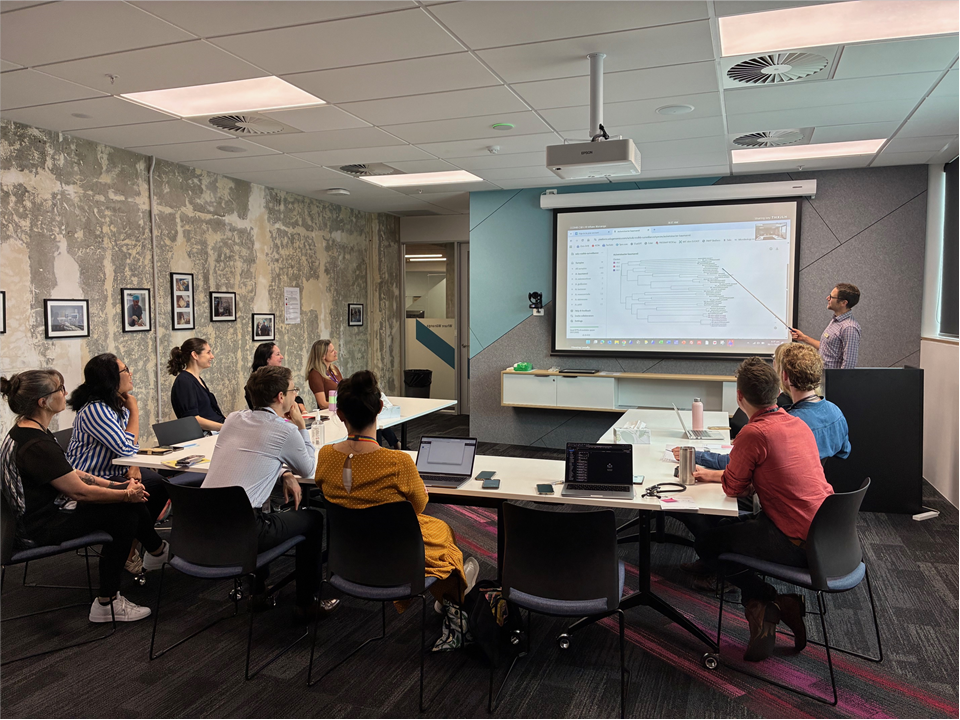
In an infection control meeting at Wellington Regional Hospital, Dr Bloomfield opens his laptop and pulls up a phylogenetic tree from samples the lab staff have recently analyzed.
"I'm accessing the results from an infection control meeting. We've done that a number of times. It's been like doing live bioinformatics, basically, which is quite cool."
Dr Max Bloomfield
Awanui Labs Wellington
A few years ago, a lab like his couldn't have done this. Dr Bloomfield is an infectious diseases physician and clinical microbiologist at Awanui Labs Wellington, which provides services to Wellington Regional Hospital, where he is closely involved in the hospital's infection control. His days are divided across three fronts. He cares for the more complex infection cases on the ward, bridges the lab and the clinical teams trying to interpret the results, and runs the genomics research that's earned him recognition.
Much of his work comes down to one question: do the cases add up to a real problem, and what should be done about it? By pairing front-line sequencing with rapid cloud-based analysis using Solu, he runs a high-resolution pipeline that has cut bioinformatics turnaround from weeks to minutes.
The response has been enthusiastic. Dr Bloomfield has showcased the lab's work to infection control teams around the country, and they've recognized the potential and want to replicate what Awanui Labs Wellington is doing.
Where it all began
Dr Bloomfield's interest in infectious diseases started with fascination.
"I always found infections and infectious diseases very interesting. It was just the way they interact with the immune system of the body."
Dr Max Bloomfield
Awanui Labs Wellington
He trained in clinical microbiology and infectious diseases, and the work pulled him towards infection control. So many of the infections he treated had been picked up in hospital that tracking transmission on the wards became a natural focus.
The idea to use genomics to look for problems prospectively took hold at a conference, where Dr Bloomfield came across it for the first time. He chose nanopore sequencing because it fit a working clinical lab. The team started simply, with MLST typing and species identification, which wasn't very heavy on the bioinformatics side, but got them further than normal surveillance.
Delayed high-resolution data analysis
Combining MLST with epidemiological data gave a reasonable guess at whether cases were connected. But without high-resolution data, a degree of inference remained. Sometimes that meant overreacting to a situation and imposing infection control precautions that weren't needed. Other times it meant not reacting in time.
What they needed was analysis at single-nucleotide (SNP) resolution.
"Getting to that high-resolution, SNP-based analysis is what does it for us. That was a huge game changer."
Dr Max Bloomfield
Awanui Labs Wellington
SNP analysis gave them the high-resolution data they needed, but getting it meant sending samples to the reference laboratory, causing delays that are not ideal for infection control.
Introducing Solu: actionable outbreak analysis in minutes
Dr Bloomfield assumed there was a ceiling, and that the most demanding analysis would always be outsourced. Then Dr Rhys White, a bioinformatician at PHF Science, the national reference laboratory for pathogen genomics, showed him Solu, a real-time genomic surveillance platform. The speed and quality of the first results impressed him straight away, delivering the high-resolution analysis the team thought they could only get from the reference lab.
"I was extremely impressed, in terms of the speed of the results and the quality of the results that came back. It was very clear to me from the get-go that it was going to be very useful for us."
Dr Max Bloomfield
Awanui Labs Wellington
What also stood out for Dr Bloomfield was the ease of use. Being able to drag and drop their files and have an answer back in a very short time frame was exactly what they needed.
Since then, Solu has changed the way the team operates.
Real-time genomic surveillance
The lab staff run the sequencing and upload the files, so Dr Bloomfield can open the results anywhere with an internet connection, including from an infection control meeting. He can bring up the phylogenetic trees and talk them through with the team before they decide how to act.
Secure collaboration across the country
Sharing data securely across teams used to be one of the invisible bottlenecks. With Solu, teams across the country can now view the same results at the same time, and interpret them together despite being in different locations.
For Dr White, that collaborative element is one of the platform's most striking features.
"That ability to connect front-line laboratories, infection-control teams, and reference-laboratory expertise and resources in real time is one of the most powerful parts."
Dr Rhys White
PHF Science
Clarity before you act
Because the answer comes quickly, Solu saves the infection control team a lot of time by helping them avoid chasing problems that turn out not to be real. They can hold off a disruptive decision such as cohorting patients, blocking admissions, sometimes closing a ward, until they have the evidence to inform that call.
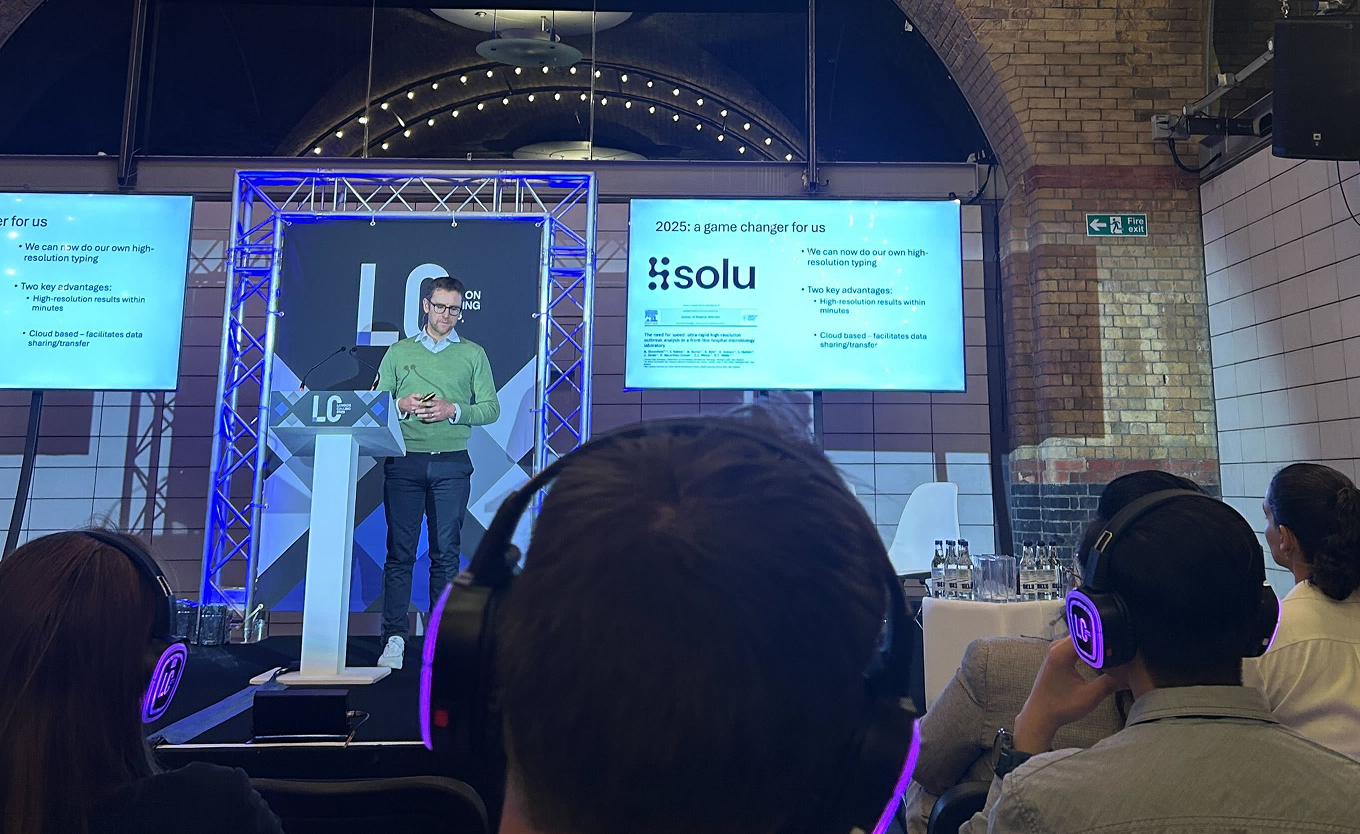
In 2025, Dr Bloomfield and colleagues published a paper in the Journal of Hospital Infection on running ultra-rapid high-resolution outbreak analysis in a front-line hospital microbiology laboratory using Solu, partly to show other similar labs how it could be done. The bioinformaticians at PHF Science were closely involved throughout, and the lab could not have done it without them, Dr Bloomfield says.
Where the field is moving
Dr Bloomfield is convinced the direction is set, with sequencing moving closer to the front line and cloud tools making it easy to share data across hospital networks. Having sequencing available and being able to analyse the results quickly is a real advantage, and he expects the shift to continue.
His own plans run in the same direction. The lab already accepts patients from a number of other secondary hospitals, and Dr Bloomfield would like to bring those hospitals into the programme, then ultimately expand to a national surveillance program. At that scale, a platform that already pools and compares data across sites could show how organisms move across a whole country rather than a single ward.
Automating more of the wet-lab workflow is another area Dr Bloomfield's team has been exploring. The dry-lab analysis is now largely hands-off, and bringing similar automation to the wet-lab side is a natural next step as the programme grows.
Ask him what he would tell the version of himself just starting out, and the answer is simple.
"I didn't think we would be here. I probably wouldn't have believed myself. At the time I thought generating an MLST was about what we could do."
Dr Max Bloomfield
Awanui Labs Wellington
"It's where I really hoped we would get to, and I'm extremely pleased we are."
Dr Max Bloomfield
Awanui Labs Wellington
The hardest part for a clinical laboratory is no longer the sequencing. It is interpreting the results fast enough to act. With the next-generation sequencing pipeline built by Dr Bloomfield and his team, and Solu's analysis support, they finally can. Ultimately, while the technology is striking, the underlying goal remains simple: fewer patients picking up an infection that could have been prevented.