Designing Solu's plasmid annotation and visualization
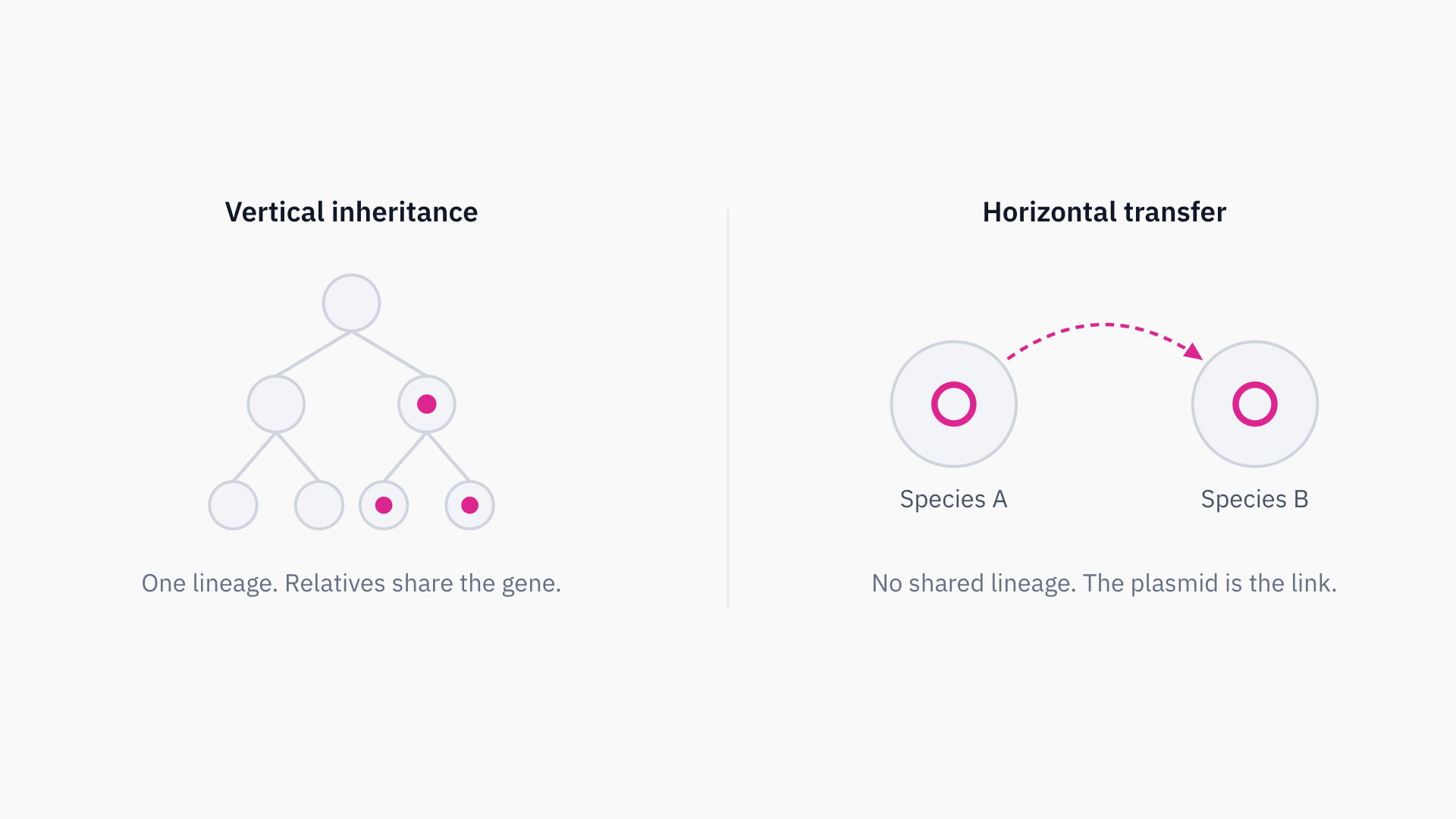
Plasmids carry resistance genes between bacteria, sometimes across species. Solu now annotates them and maps what they carry.
Why we built it
We learned how much plasmids matter from our customers. They were already working with them, piecing results together with their own scripts, and we wanted to make that part of their work easier.
The stakes are well established. Bacterial antimicrobial resistance was associated with an estimated 4.95 million deaths in 2019, 1.27 million of them attributable directly to it.¹ Plasmids can play a part in how that resistance spreads,² and where they do, a lineage comparison may not connect the cases.
What plasmids add
Most genomic surveillance follows vertical inheritance: compare isolates, find close relatives, work out who passed what to whom.
Plasmids can move between bacteria instead, sometimes between species. Horizontal gene transfer is one of the main routes by which antibiotic resistance spreads.² For example, IncX3 plasmids have been reported carrying blaNDM in several species.²
Two isolates can share a resistance plasmid while their lineages show no connection at all. Comparing family trees finds nothing. Looking at plasmids finds the link.
Comparing genomes finds the connection on the left. On the right it takes looking at the plasmid.
What you get
- The whole plasmid annotated. AMR and virulence genes, mobile elements and coding sequences on one map
- Acquired DNA. GC content and GC skew reveal stretches that differ from the rest of the sequence.
- Mobility. Replicon and relaxase typing, and whether the plasmid can transfer itself.
- Public comparison. The closest matching plasmid in public databases, with a similarity score.
- Export. The figure as PNG, the annotations as GFF, or the sequence as FASTA.
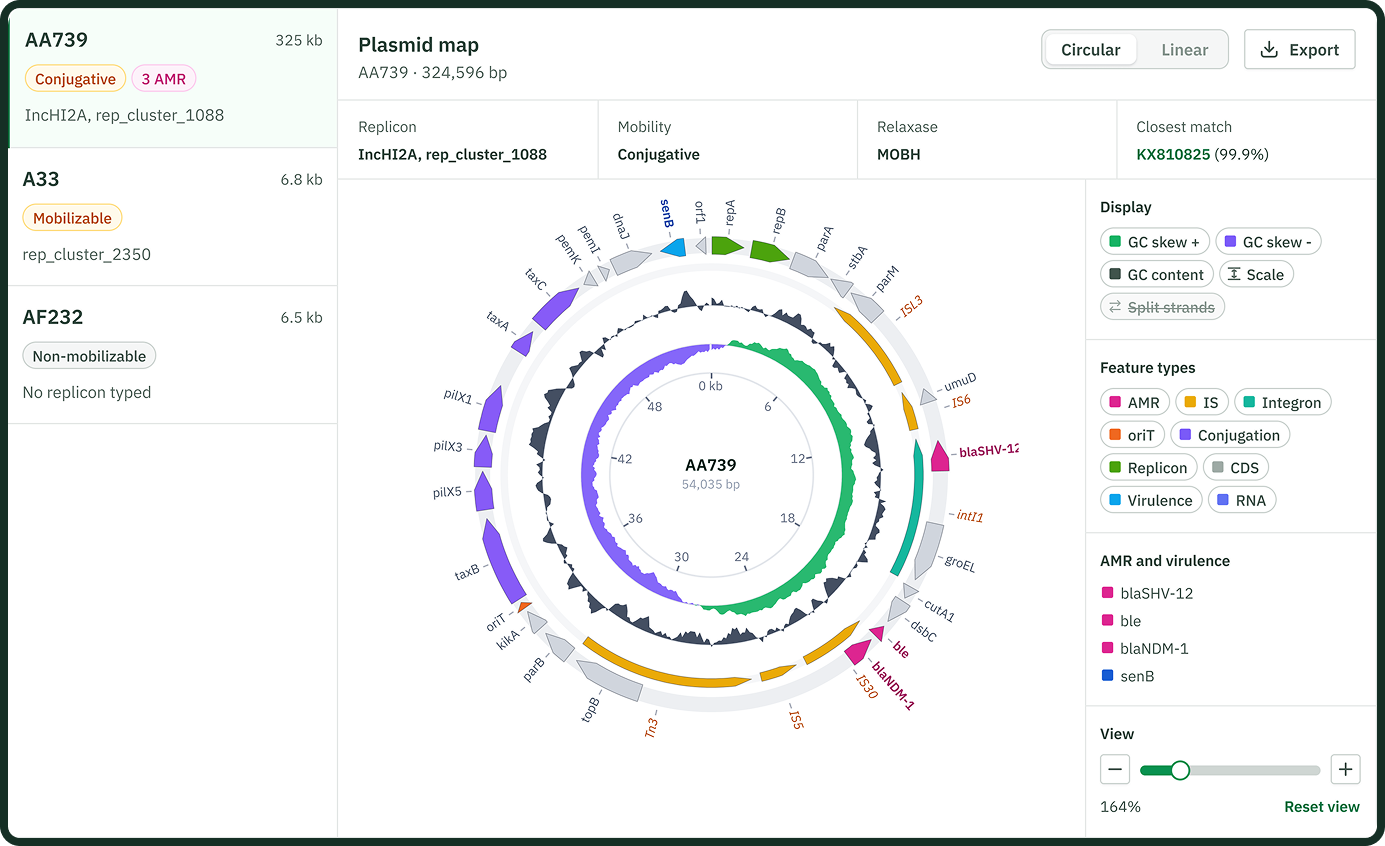
It runs on data you have already uploaded. Plasmids are reconstructed and typed with MOB-suite, features called with Bakta, insertion sequences with ISEScan, integrons with IntegronFinder, and GC content and skew computed with Biopython. Resistance and virulence genes are not re-called here; they come from the sample-level AMRFinderPlus and ABRicate/VFDB results and are mapped onto the plasmid.
You can read more about it in our methodology and citation page.
How we designed it
We started with the biology rather than the screens. Our cofounder Jonatan gave a talk to the whole team on what plasmids carry and what an annotation can tell you.
We then shared early versions with users while they were still unfinished. Their feedback shaped the final result.
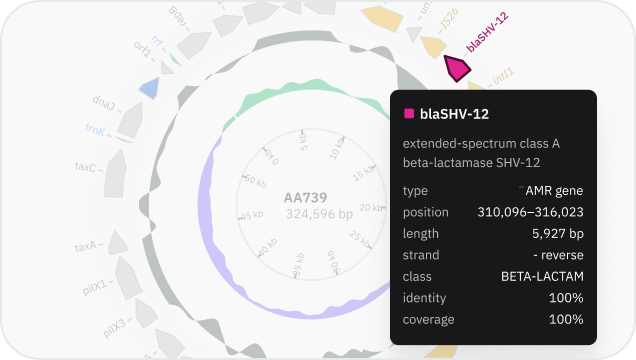
An interactive layer. Hover any gene to dim the rest of the map and read its position, length, strand and type. Toggle tracks and feature types to isolate what you are looking at.
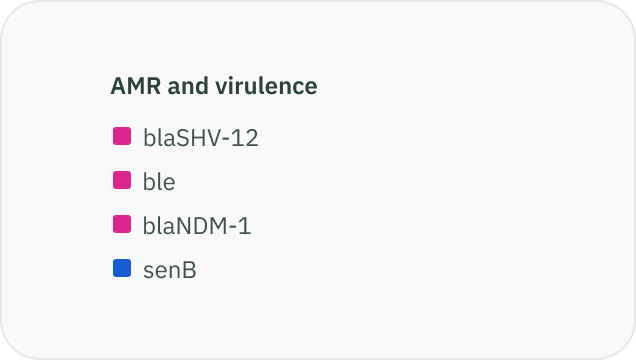
AMR and virulence listed. Resistance and virulence genes are highlighted on the map and listed in the panel, so you can judge whether a plasmid is worth following up with the full analysis.
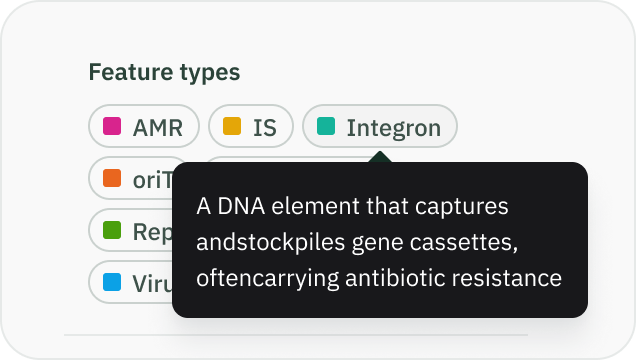
Terminology explained. GC skew, relaxase and MPF carry a lot of meaning in few characters. Every label explains itself on hover.
What is next
We want to learn more about how plasmids are used in practice, so if you work with them, tell us how. The people using Solu shaped this version, and we want them to shape the next.
References
1. Murray CJL, et al. Global burden of bacterial antimicrobial resistance in 2019: a systematic analysis. The Lancet, 2022.
2. Partridge SR, Kwong SM, Firth N, Jensen SO. Mobile genetic elements associated with antimicrobial resistance. Clinical Microbiology Reviews, 2018.